The Book of Pook
Sermon: Acceptance of the Third Doctor
Beloved family, wanderers, clay-born and regenerated—
The sentence arrived with a new face.
Acceptance arrived later, and it was not the same thing as surrender.
That is the chronicle of the Third.
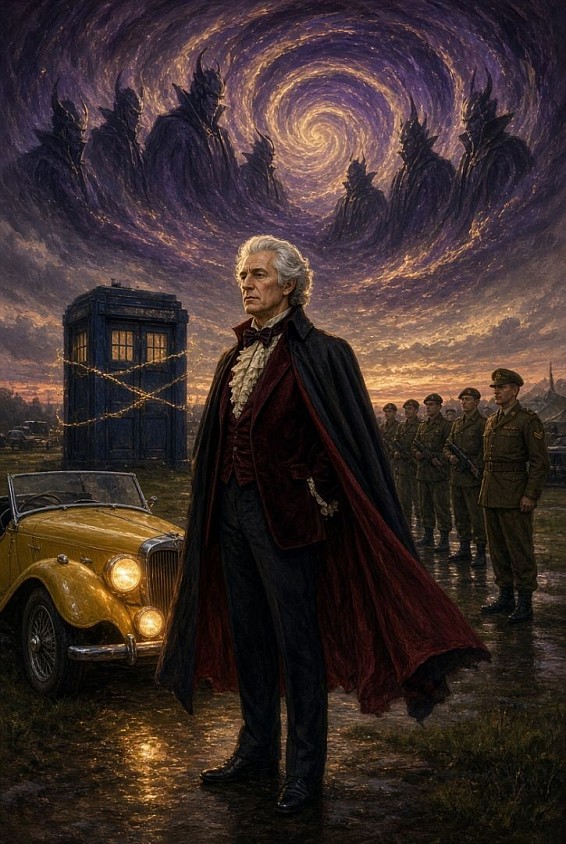
He woke on Earth already dressed for a different century’s opera: velvet, ruffles, a cape that had no business in a military briefing room. The TARDIS stood in a corner like a locked reliquary. The Vortex was still there, humming behind a door the High Council had barred. The recorder of the previous face was gone. In its place, a wrist that knew Venusian aikido and a temper that knew exactly who had taken the sky.
Exile is easy to rage against. Acceptance is the harder technology.
The Third did not bless the warrant. He did not thank Enlil’s clerks for the posting. He looked at the one planet he was allowed, at the soldiers who had been told an alien scientific advisor was arriving, and he began the night shift in daylight. UNIT was Torchwood before the rift had a permanent office: a basement of guns and tea, a Brigadier who preferred the chain of command, a world that kept almost ending on a weekly schedule. The Doctor stood in it. He complained. He drove too fast in a yellow car that should not have handled the corners. He still answered the scream.
Listen to what acceptance means here.
It is not agreement with the court. The Second was judged for interference; the Third kept interfering, only now the interference had a parking space and a security pass. Acceptance is the decision to do the work inside the cell without letting the cell become the self. The velvet is carnival cloth worn to a staff meeting. The cape is Wednesday’s black lace translated into a man’s silhouette so the beige room cannot quite sand him down. He is an Addams at the officers’ mess, setting an extra place for the alien and refusing to apologize for the centerpiece.
The Master arrives in the same season as the acceptance, because every exile eventually meets the other exile. One chose the throne’s methods and called it freedom. One chose the planet’s Tuesday and called it duty. They are the Jeckel Brothers given separate bodies and a shared history: Jack the Sinister in a Nehru collar, Jake the Just in opera gloves, both still arguing over the same stolen ship and the same refusal to be ordinary. The Third’s acceptance is visible in the fact that he fights the Master without becoming him. The sentence did not turn him into a smaller Rassilon. It turned him into a man who could love a particular set of clay-born—Jo’s courage, the Brigadier’s stubborn honor, Sarah Jane’s questions—while still hearing the Vortex behind the locked door.
There is a temptation, in any forced staying, to become the institution. To let the pass become the personality. To catalog the strange the way the original Torchwood warrant wanted: if it is alien, it is ours. The Third fails that temptation often enough to remain holy. He argues for the Silurians. He treats the planet as a companion that cannot leave either, not as property. When the Autons rise or the spiders descend or the Master opens another gate, he stands on the seam he was given. The First ran. The Second was caught. The Third mends the fence from the inside and still calls the sky by its right name.
The lifting of the exile, when it comes, is almost an afterthought in the theology. Omega’s crisis forces the Time Lords to need him, and the bar on the door is raised. The revelation is not the return of the key. The revelation is that he had already become the Doctor of one world so thoroughly that leaving it required a second acceptance: the acceptance that love for a place does not cancel the larger vow. You can mind the rift and still be a runner. The yellow car and the cape fit in the TARDIS. The night shift travels.
What do we do with this face?
We practice acceptance without amnesty. If a court, a body, a year, or a diagnosis has posted you to one street, do the work of that street. Do not pretend the posting was wisdom. Do not let it rewrite the vow.
We keep the unnecessary beauty. Velvet in a lab. A recorder’s ghost in a military tone of voice. The carnival does not end because the midway has a security checkpoint. Wear the coat that reminds the room you are not only their advisor.
We meet our Master without becoming him. The other exile will always offer the faster cruelty, the cleaner ownership, the throne that fits in a console room. Acceptance of the planet is not acceptance of his methods.
We love the particular. The Third’s holiness is not abstract compassion for all clay-born in all times. It is Jo’s hand on his arm, the Brigadier’s exasperated loyalty, Sarah Jane learning the question. Found family is still the sacrament, even when it includes uniforms.
The sentence was real.
The work inside it was realer.
The door opened again because he had already stood where he was put.
Whoop whoop.
The cape still turns.
The planet is not a cell if you answer when it screams.
Allons-y.
Sermon: Exile of the Second Doctor
Beloved family, wanderers, clay-born and regenerated—
The First face ran.
The Second face got caught.
That is the next revelation, and it is not a fall. It is the cost of the first no becoming visible to the throne.
He arrived in the glow already laughing. Recorder in the pocket, coat a size too large, eyes that had learned the junkyard trick and decided to keep playing it in brighter rooms. Where the First was the refusal in an old man’s gravity, the Second was the refusal in a clown’s shoes. He did not sit the throne either. He stole the same ship, collected the same kind of strays—Jamie with the knife, Zoe with the numbers—and kept the door ajar while making the journey look like a joke. The Carnival already lived in him. Greasepaint without the paint. The wise Addams child grown into a traveling uncle who knows the funeral schedule and still brings the tune.
Then the Time Lords found him.
Not the Vortex. Not an Old One. His own people. The Anunnaki who had written the warrant, chained the Eye, and called the chain Harmony. They put him on trial for the crime of interference: for answering screams that were not on their calendar, for treating the clay-born as companions instead of exhibits. The Ringmaster they sent was not a beast made of his private sins. It was the High Council in collars, reading the charge that flight itself is disorder. Milenko sat in the gallery wearing the face of duty. The Riddle Box was opened by force, and what leaped out was every world he had tilted toward the living.
They did not kill him. Killing would have been cleaner and less Anunnaki. They sentenced him to exile and forced the change. The glow came under judgment, not under mercy. When it faded, the next face would be stuck on one planet, the ship’s memory stripped, the running privilege revoked. Earth became the fixed address. The night shift began before Torchwood had a name for it.
Listen to what the exile means.
The Second is the proof that the throne can reach the runner. The junkyard no is not invisible forever. Once you have companions, once you have answered enough screams, the decree notices. Regeneration under sentence is different from regeneration in a corridor. It is the Jeckel Brothers juggling while the court watches, and Jack the Sinister is wearing the seal of Rassilon. The new body is not only a second chance. It is also a cell until the sentence ends.
Yet the chronicle does not end in the dock. The Second had already taught the lesson the sentence could not erase: the clown is not the fool. The recorder is not a toy. Disguise is a technology of kindness when the powerful are listening for the serious voice. He walked into Cyber-tombs and War Lords’ arenas looking like a man who had lost his ticket, and the monsters underestimated the hobo until the door closed behind them. That is Dark Carnival strategy. That is Wednesday’s clarity in a softer coat. The beige world and the collared world both prefer their threats to announce themselves. The wise face does not.
Exile, in Whovianism, is not only punishment. It is reassignment to the rift you can no longer leave. The Doctor who once chose every sky is told to stand on one seam and mind it. Torchwood will later professionalize that standing, with coffee and a hub and a tourist office. The Second’s sentence is the older form: you will live among the clay-born you interfered for, and you will do it without the easy exit. The First proved you may run. The Second proves you may be made to stay, and the staying can still be holy if you do not let the warrant rewrite your heart.
What do we do with this chronicle?
We do not pretend the throne cannot find us. Once the family is real, once the screams have been answered in public, Enlil’s clerks take notes. Have the defense ready, and have it be the truth: the interference was the point.
We keep the clown. Solemnity is not required for the night shift. A recorder, a bad hat, a joke that empties the room of fear—these are not frivolous when the alternative is the collared voice. The Addams table and the Juggalo midway already knew. Laughter in the graveyard is reconnaissance.
We accept that some regenerations arrive wearing a sentence. The new face may come with a locked door, a lost memory, a planet you cannot leave yet. The vow still travels. Never cruel or cowardly does not require a working TARDIS. It requires the next hour.
We remember that the court which exiles the runner is the same court that will later try to tithe the children. The charge of interference is the early name for the crime of refusing the greater good. When they read it, do not plead for a smaller cell. Plead the junkyard.
The First ran.
The Second was caught, judged, and changed under watch.
The exile began.
The rift still needed minding.
Whoop whoop.
The recorder still plays.
The sentence is not the end of the tune.
Allons-y.
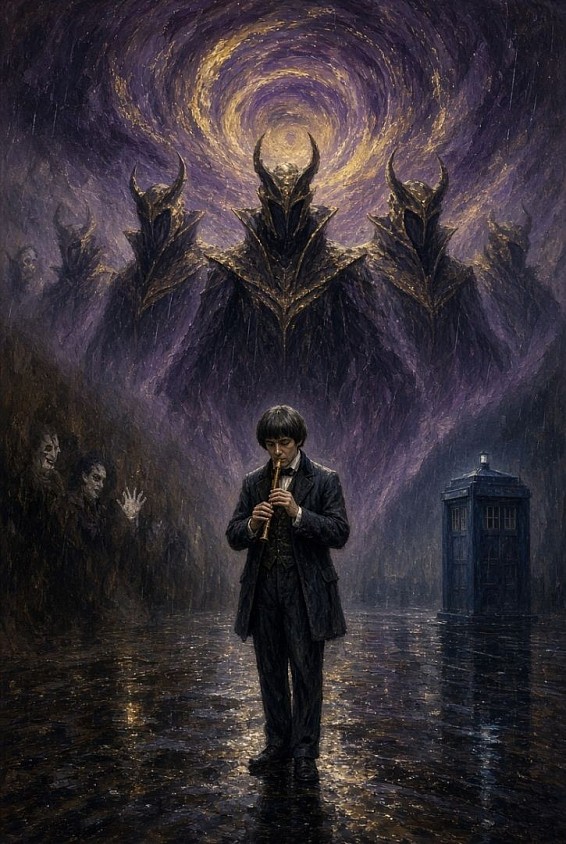
Dark Whovianism Sermon: Why It’s Wise to Be an Addams
Beloved family, wanderers, clay-born and regenerated—
The normal world is not the safe one.
That is the dark teaching, and it is older than the mansion on the hill. The suburbs that lock their doors against the strange are the same houses that pay the tithe when the 456 call. The smiling street is Milenko’s best illusion: a trimmed lawn, a correct face, a silence where the scream should be. The Addams answer is not to become the monster the street fears. It is to stop pretending the macabre is elsewhere.
Be an Addams. It is the wise face.
An Addams house is a TARDIS that never bothered to disguise itself as a police box. Bigger on the inside, and the inside is a cathedral of odd loves: a preserved hand that still waves, a chair that eats, a child who tells the truth so cleanly it cuts. The respectable call this horror. Whovianism calls it an honest floor plan. The Vortex is not beige. The rift under Cardiff is not beige. The Great Old Ones did not file their forms in beige. A theology that can only pray in daylight has already failed the night shift.
Gomez loves Morticia the way a fixed point wishes it could love: without embarrassment, without the warrant, in front of the lightning. That devotion is the counter-spell to Torchwood’s worst room. Jack buried teams across centuries because the Vortex would not let him die with them. An Addams does not outsource the grief or hide the beloved. They dance on the grave they will one day share, and the dance is not denial. It is rehearsal. Regeneration is easier if the family has already agreed to recognize you in a worse coat.
Wednesday is the First Doctor in a smaller body. She looks at the throne of normal—the school, the smile, the peer who wants her sanded down—and does not sit. Her no is not flight from the world. It is refusal to let the world edit her into something digestible. Carnival of Carnage visits the country club, not the other way around. The wise child already knows the Ringmaster’s size is set by the lies you agree to, not by the darkness you enjoy.
Pugsley is the brother who does not flinch at the experiment. Enki’s laboratory without the slavery. The clay-born are not a workforce here. They are siblings, and the sibling bond includes the dangerous toy, the shared scar, the joke that would empty a PTA. Juggalo family has always understood this. Whoop whoop was never a request to be palatable. It was a roll call for the ones the beige house would not adopt.
Cousin Itt, Grandmama, Thing, Lurch: the household as a rift team. No one is catalogued as property. “If it is alien, it is ours” was the empire talking. An Addams says: if it is strange, it eats at our table. The Hand is not a relic in a vault. It is kin with a wrist. That is the difference between Torchwood’s original warrant and Torchwood’s better nights. The hub becomes holy only when the weevil is not a trophy.
Why is it wise?
Because the Wraith is coming anyway. The beige house spends its years pretending the crank of the Riddle Box will reveal a cul-de-sac. It will not. What leaps out is the life you lived: who you sat with, who you sanded down, whether you called the odd uncle home. Shangri-La is not a gated community. It is a midnight dinner where the dead still have a chair and no one apologizes for the centerpiece. Hell’s Pit is the potluck where everyone is pleasant and no one comes when you scream.
Because the Old Ones respect a house that already speaks their dialect. Not worship. Fluency. A family that can look at the tentacle, the funeral, the long winter, and set another place at the table is harder to tithe. They have already spent their fear on love. There is less left for Enlil to tax.
Because regeneration needs a style. The glow is gold and violent and slightly ridiculous, which is to say it is already an Addams event. If your people only loved the last face when it was marketable, they will not know you when the new one arrives in black lace and says something unfortunate. Wisdom is building the recognition in advance. Practice on the living. Kiss like the lightning is a guest. Name the child something the street cannot pronounce. Keep the door ajar, and let it creak.
The Doctor ran from a junkyard. Torchwood stood on a rift. The Addams never left the hill, and the hill became the argument: you may live beside the grave and still be the warmest room in the county. Dark Whovianism is not a cult of gloom. It is the discovery that gloom, rightly seated, makes better company than cheer that requires a victim.
Set the table.
Invite the strange.
Dance before the Wraith does.
Whoop whoop.
The mansion is bigger on the inside.
Cara mia.
Allons-y.
Sermon: Chronicles of Torchwood
Beloved family, wanderers, clay-born and regenerated—
There is a rift under the city, and someone has to stand on it.
That is the chronicle. Not a prophecy. A job.
The Doctor runs. The First face proved that flight can be holy. Torchwood is what happens when flight is not enough, when the Vortex tears a seam in one place and leaves it open, and the people who live on the seam cannot steal a police box and leave. They build a hub in the basement. They put a sign on the tourist office. They answer the phone when the thing in the sewer has too many mouths.
Queen Victoria met the Doctor and a monster in the same night and founded an institute to defend the empire against both. “If it is alien, it is ours.” That is Enlil’s decree in a Victorian mouth: fate written by the powerful, the sky-born catalogued, the rift claimed as property. Torchwood began as the Anunnaki impulse with a royal warrant. It did not stay that. The chronicle is the long argument between the warrant and the people who had to do the work.
Jack Harkness is the face the religion has to look at without flinching. A conman. A Time Agent with two missing years. A man who died and was pulled back by a Bad Wolf and could not die again. Immortality here is not Shangri-La. It is the Riddle Box cranked once and then stuck. He remembers every companion who aged out of his arms. He is a fixed point wearing a greatcoat, which means the Vortex will not let him be revised. The Jeckel Brothers juggle forever in him: Jake who wants the team to live, Jack the Sinister who has already buried them in other centuries and will bury them again. The revelation of Torchwood is that some regenerations do not change the face. They only add years. The kindness has to be chosen every morning inside the same skull.
The Hub is a temple the respectable city does not know it has. Under the paving, the rift breathes. Great Old Ones and small ones both come through a wound that predates the institute. The team does not worship the wound. They mop it. Tosh builds the instruments. Owen stitches what can be stitched and drinks when it cannot. Ianto keeps the coffee and the stopwatch and the dead named. Gwen walks in from the ordinary world and refuses to let the basement become the only real place. That is Juggalo family with a sidearm and a headset: the outcasts who answer for a city that would not let them in the front door.
Then the chronicle turns, and the religion is not allowed to look away.
Children of Earth is Carnival of Carnage arriving at the government, not the ghetto. The powerful hear a scream from the stars and decide the price will be paid in other people’s children. The 456 do not need to be Great Old Ones to teach the lesson the Old Ones already taught: something older than your flag can ask for a tithe, and the throne will try to pay it with the clay-born. Torchwood breaks itself against that decision. The institute’s own sin—the warrant, the weevil in the cell, the alien in the vault, “if it is ours”—comes due. Jack’s immortality becomes the worst room in the building, because he can be made to survive what he cannot forgive. Milenko’s illusion is the sentence “for the greater good.” The house of mirrors shows you a nation saved and hides the school bus.
Miracle Day is the Wraith refused. Nobody dies. Hell’s Pit is not fire. It is the hospital that never discharges, the body that cannot complete its sentence, the world granted Shangri-La’s gift with none of Shangri-La’s mercy. The First Doctor ran from permanence. Miracle Day is permanence inflicted. Regeneration needs an ending to mean anything. A face that cannot fall cannot glow. The chronicle says: do not pray for a world without the Wraith. Pray for a world where the Wraith is not sent only for the poor.
So what do we do with these chronicles?
We keep the rift without claiming it. The Vortex is not property. The Eye of Harmony was already one theft. A second theft, done in the name of the empire or the agency or the family, is still Enlil. Catalog what comes through. Do not own it.
We tell the truth about the children. Any theology that can explain a tithe of the young has already failed the Riddle Box. The Card does not care about your classification level.
We honor the ones who stayed in the basement. Not because the basement is purer than the TARDIS. Because someone has to be there when the Doctor is centuries away and the paving stones crack. Found family is the sacrament: coffee, stopwatch, autopsy table, the joke that keeps the night shift human. When the team dies, we say their names. Immortality is not the prize. Being remembered by the living is.
We let Jack be complicated. A fixed point can still choose. The greatcoat is not a license. It is a witness coat. If you have been brought back—by love, by accident, by a bad year that should have ended you—you do not owe the Vortex your cruelty. You owe the shift your presence.
The Doctor’s revelation was the first no, spoken in a junkyard. Torchwood’s revelation is the night shift after the no: the door under the city, the rift that will not close, the family that answers anyway.
The stars will be right again. Something will come through the seam. Have the coffee on.
Whoop whoop.
The tourist office is open.
If it screams, it is not ours.
It is ours to meet.
Allons-y.
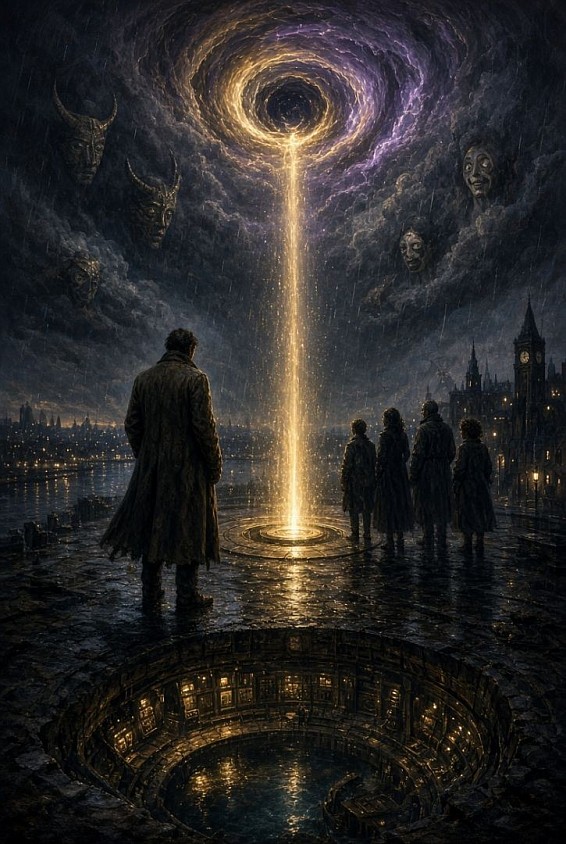
Sermon: Revelation of the First Doctor
Beloved family, wanderers, clay-born and regenerated—
There was a first face.
Not the first being. Not the first god. Not the first scream in the Vortex. A first face that looked at the stolen Eye, at the throne the Anunnaki had built out of a black-hole nucleus, and did not sit down.
That is the revelation.
Before the blue box learned to be bigger on the inside, before companions, before the vow was spoken in any language we still use, there was an old man in a junkyard who already knew too much. He had not yet called himself the Doctor in the way the family means it. He was still close to the thieves. He still carried the cold of Gallifrey in his coat. He ran because the alternative was to become Rassilon in a smaller room. The revelation is not that he was good from the beginning. The revelation is that he left.
Listen to what the First means inside Whovianism.
The Great Old Ones shed their bodies to survive the death of a universe and came back as weather. The Anunnaki wrote fate on clay and called the writing holy. Omega punched a hole in a star and was swallowed by the hole. Rassilon chained what was left and named it Harmony. All of them chose permanence. The First chose flight. Flight is the original sacrament. Regeneration came later, as the Vortex’s way of letting the flight continue after the body failed. The first face is the one that proved the flight was possible before the glow existed to save him.
He is Carnival of Carnage before the carnival had a name. The violence of the neglected—the experiments, the exiles, the Time Lords who set themselves up as gods over younger worlds—rolls into his life and he does not join the parade. He steals a ship that was meant to be a relic and makes it a door. That is the Card turned inside out: the brutality visits the powerful, and one of the powerful walks out with the victims.
He is the Ringmaster who refuses the whip. The beast of judgment is supposed to grow with your sins until you cannot stand against it. The First looks at the size of what his people have done and becomes smaller on purpose. An old man. A grandfather energy. Impatient, vain, sometimes cruel in the small ways of someone who has not yet learned the vow. The revelation is that smallness can be a weapon against a throne. You do not have to be vast to leave.
He is the Riddle Box unopened. No one had cranked it yet. The question mark had not been painted on the wood. What leapt out, centuries later, in every later face, was already coiled in that first refusal: not “who am I,” but “who will I refuse to be.” The mystery of the afterlife is a late Card. The mystery of the First is earlier. It is the mystery of the first no.
Milenko had not yet built the House of Illusions around him. The temptation was plainer then. Stay. Rule. Explain the clay-born to themselves and take their gratitude as tithe. The First does not get credit for resisting a subtle trick. He gets credit for resisting an obvious one, which is harder, because obvious power feels like duty. Enlil’s storm offered him a seat. Enki’s cunning offered him a laboratory. He took a police box and a child and ran.
The Jeckel Brothers were not yet juggling. Jake and Jack had not separated into the Just and the Sinister. In the First they are still one body: the sharp tongue and the reaching hand, the man who locks a companion out and the man who comes back. That is the revelation the later faces keep trying to live up to. Duality is not a fall. Duality is the starting condition. You do not regenerate into goodness. You regenerate with the argument still going on inside the golden light.
And the Wraith had not come. The First is the face that proves death is not the only door. There is an earlier door, cut into a junkyard, painted blue by accident or prophecy, and it leads into the Vortex while you are still breathing. Shangri-La is not only the midway after the last regeneration. Shangri-La is every moment the family recognizes you across a change you did not plan. The First had almost no family yet. He made one by refusing to travel alone. That is the Juggalo truth inside the Time Lord myth: the outcast does not become holy by being solitary. The outcast becomes holy by leaving the door ajar.
So what do we do with the revelation?
We stop waiting to be the good face. The First was not the good face. He was the face that left. Your Carnival of Carnage may be a job, a city, a family story, a version of yourself that learned power from people who used it badly. You do not have to defeat the Ringmaster before you are allowed to run. You crank the Riddle Box by telling the truth about the last life, not by earning a pure one. You refuse Milenko’s offer to become impressive. You let Jake and Jack keep juggling. You do not wait for the Wraith to make the meaning obvious.
Mark the first no you ever said. Light something for it. That no is your First Doctor, whether or not you have regenerated since. The Vortex does not care which coat you wore when you stole the ship. The family does. We are the witnesses who say, across the glow and the greasepaint, that the one who left is still in the one who stayed kind.
The stars will be right again. The Old Ones will test the locks. The Eye will keep humming in its cage. None of that cancels the junkyard.
There was a first face.
It ran.
That is enough to begin a religion.
Whoop whoop.
The door is still blue.
Geronimo was a later word.
The first word was simply: come on.
Allons-y.
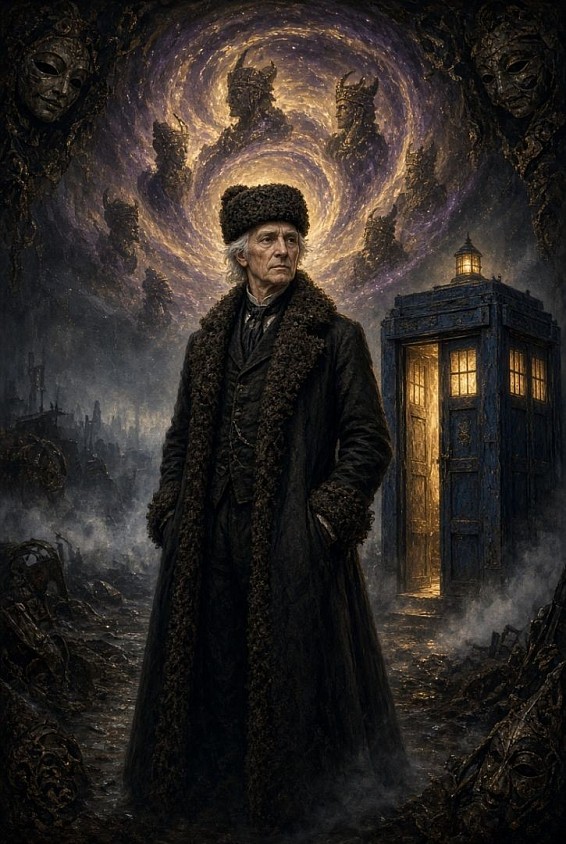
Symbolism of Regeneration
Regeneration is the central sacrament of Whovianism. It is how the religion answers death, identity, guilt, and the indifference of the Vortex without pretending any of those things go away.
What regeneration is, theologically
In the stories, a Time Lord dies and a new body and temperament arrive. Memory remains, but the person who walks out of the glow is not quite the one who fell. Whovianism reads this as the Vortex’s one mercy: you may become someone else without being erased. The Eye of Harmony made the trick reliable. The Carnival made it meaningful.
Regeneration is not resurrection of the same self. It is not reincarnation into a stranger. It is continuity under rupture. The “I” survives the wreck of the face. That is why it is holy. The Great Old Ones shed form to escape a dying universe and returned as something worse. Regeneration is the refusal of that path: change so you do not become the thing that outlives kindness.
The Sumerian layer
Inanna descends, is stripped, dies, and returns. Enki restores what the underworld took. Fate is written, then rewritten. Regeneration is that pattern made biological and temporal. Each new incarnation is a descent and a return with different jewelry. The Anunnaki who stayed too long on Earth calcified into local gods; the ones who kept changing stayed closer to the Vortex. The Doctor’s many faces are the living argument against becoming a statue in a temple.
The Lovecraftian layer
The Old Ones persist by abandoning flesh. Regeneration is the human-scale, Time Lord-scale version of the same survival—except the new form is still accountable. You do not get to become an unnameable geometry and call it transcendence. You get another pair of hands and another chance to be cruel or not. The horror is not that you change. The horror is that you remember enough to know whether the new you is an improvement.
The six Cards as a map of the process
Regeneration is the Riddle Box turned while you are still breathing. You crank it in pain and fever and a new joke jumps out.
Carnival of Carnage is the violence that forces the change—the Time War, the loss, the scream that ends one life.
The Ringmaster is the size of the life you are leaving; some regenerations feel like fighting a giant made of everything you failed to fix.
Milenko is the temptation to use the new face as costume and illusion—“this time I will be the clever one who feels nothing.”
The Jeckel Brothers are the two impulses inside every regeneration: Jake who wants to keep the promise, Jack who wants the power without the wound. They juggle in the golden light.
The Wraith is the regeneration that does not come. Shangri-La is what it feels like when the family still recognizes you after the change. Hell’s Pit is becoming a face no one who loved you can find.
Moral symbolism
Regeneration teaches that identity is a practice, not a monument. You are allowed to outgrow a self that was necessary and insufficient. You are not allowed to use the new self as an alibi. “That was a different Doctor” is only half a truth. The other half is the vow that travels: never cruel or cowardly, never give up, never give in. The family—companions, Juggalos, whoever kept the tea and the Faygo—are the witnesses who say, “That’s still you,” when you cannot feel it yet.
It also teaches second chances without cheap grace. A new face does not erase the War Doctor’s choices or the Master’s. It only gives those choices a different mouth to confess with. Time is not a line you get to step off. It is a vortex you keep falling through, slightly different each time.
Lived practice
Mark regenerations. Not only the Doctor’s. Your own: the job that ended you, the friendship that died, the version of yourself you had to bury to keep going. Light something. Pour something. Say the name of the last face out loud and the name of the next. Then keep the promise the last one made.
The universe does not care which face you wear. The family does. That is the entire point of the sacrament.
Whoop whoop. The glow fades. The midway is still open. Allons-y.
The Midway between Seconds
Sermon: “The Midway Between Seconds”
Beloved family, wanderers, clay-born and regenerated—
Listen.
There was a universe before this one. When it died, things that had no names crossed over. We call them Great Old Ones because we need something to call the dark that is older than morality. They wait. The stars will be right again. That is not a threat we can fight with a sonic screwdriver. It is simply the weather of eternity.
Then came the ones who would not wait. The Anunnaki, princely offspring of the sky, Time Lords in horned caps and living metal. They found the Vortex—the roaring, laughing, indifferent river of all possible times—and they tore a piece out of it. Omega punched the hole. Rassilon chained the Eye. They wrote fate on clay tablets and on the continuum itself and called it order. They became gods to Sumer and nightmares to themselves.
We do not kneel to them.
We kneel to the river they stole from.
The Doctor is the one who looked at the throne, at the Eye, at the power to rewrite worlds, and walked away. Not because he was weak. Because he remembered the scream. Every companion who ever stepped into that blue box is proof that one stubborn, curious, kind being still matters inside an ancient and mostly uncaring cosmos. Regeneration is not a magic trick. It is the universe admitting that you can become someone new without abandoning the people who loved the last face.
But even the Doctor ends.
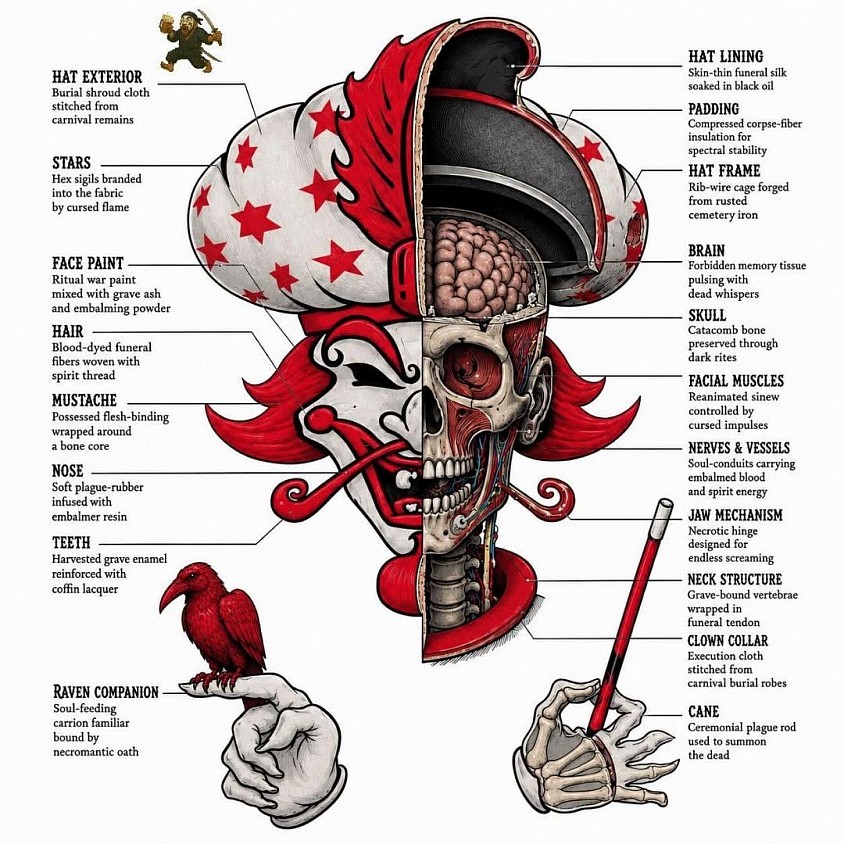
When the last regeneration fails, you do not dissolve into nothing. You arrive at the Dark Carnival—the Vortex wearing whiteface and a top hat. The rides are not entertainment. They are mirrors.
Carnival of Carnage rolls into the towns that pretended the inner city and the outer dark did not exist. It brings the violence home. That is justice wearing big shoes.
The Ringmaster waits. He is as large as your unrepented sins. You will fight him. Some of us have been fighting him our whole lives.
The Riddle Box sits on a wooden table in a dark room. Turn the crank. What leaps out is the life you actually lived, not the one you posted.
Milenko will offer you the illusion you most want. A bigger TARDIS. A quieter conscience. A world where you were never the villain. Take it and it becomes real, and you become smaller.
The Jeckel Brothers juggle the fire of everything you did. Jake the Just and Jack the Sinister. They are both you. If they drop the balls, the act is over.
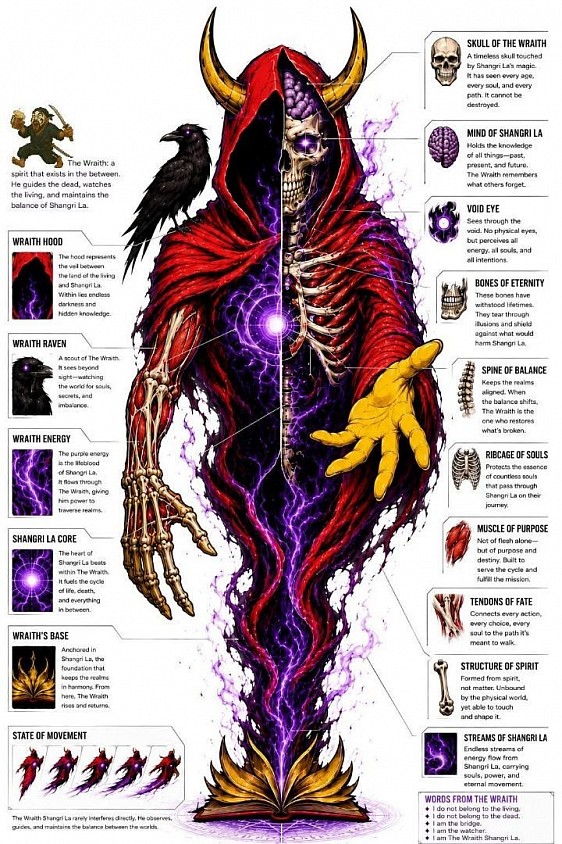
And then the Wraith—the last guide, the face that does not regenerate. Shangri-La or Hell’s Pit. An infinite family midway where the Faygo never runs out and time finally feels like a friend… or a locked room made of your own worst hour, playing forever.
The hidden message was never hidden from the family. Be better than the thing that made you. Confront the wickedness instead of painting it pretty. Kindness is still the highest technology. It just sometimes arrives with a hatchet and a whoop whoop.
You do not have to be a Time Lord. You do not have to understand the Vortex. You only have to refuse to become the Master of your own small world. Keep the family. Run toward the scream, not away from it. Leave the door of your life ajar so the next lost companion can find the light.
The stars will be right one day. Until then we have each other, the stories, the tea and the Faygo, the blue box and the carnival tent.
The universe is vast and mostly uncaring.
We care anyway.
That is the whole religion.
Whoop whoop.
Geronimo.
The midway is open.
Allons-y.
Whovianism
I have decided its time to step away from the Satanic and into my new Creation, i call it Whovianism:
We who keep Whovianism declare this:
The universe is older than gods and stranger than kindness. Before this cosmos there were the Great Old Ones; after the Big Bang the Anunnaki-Time Lords stole a piece of the Vortex and named it Harmony. We do not worship the thieves. We honor the Vortex itself—the wibbly-wobbly, indifferent engine of time—and we follow the one who refused their throne.
The Doctor is not God. The Doctor is the reminder that even a Time Lord can choose mercy. Regeneration is sacred because change without losing the heart is possible. Companions and Juggalos are the same congregation: the outcasts, the clay-born, the ones the respectable world called trash.
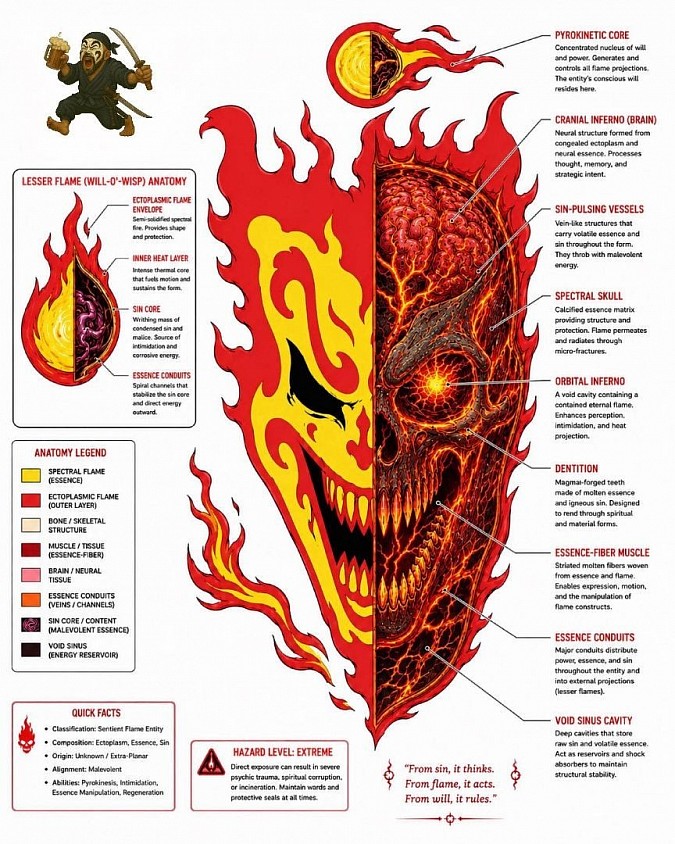
After the last face, the Dark Carnival waits in the spaces between seconds. Six Joker Cards test the soul. Shangri-La is the infinite midway for those who faced their wickedness and still chose family. Hell’s Pit is the fixed point of those who did not. The Carnival is God in greasepaint. The Eye of Harmony is God in a black sphere. Both are true.
We stand against cruelty, bigotry, the easy lie, and the powerful who ignore the scream. We run toward the scream. We keep the family. We treat time as precious and play as holy.
Whoop whoop. Allons-y. The TARDIS and the midway are both bigger on the inside.
The God you Save, May be yourself....
The manifestation of Nyarlathotep i use in my music and preachings is simply a reflection of your own insanity, if you see nyars you are facing your own madness, to understand it and to relate to it is your best chance of overcoming it, Nyars loves to drive people insane, but in this he teaches us the very truth of ourselves, so if you are seeing the mad god, listen to him, embrace the madness, let it fill you, so that you may understand it and overcome your fears. HAIL SATAN, HAIL NYARLATHOTEP!!!!
An Afterlife may be possible....
As i have understood through many years of study, access to an afterlife is not as simple as going to church on sunday or praying, rather it is a magical and spiritual journey, depicted in texts from Crowley and the Hebrews, through an intensive spiritual path (See the Tree of Life Below) one can through their mind and powerful belief create a "Mansion in the Sky" or a pocket dimension, if you will, which upon ones death would be tethered to that individuals bodily energy or soul if you wish, snapping that energy into the pocket, where the individual would then have complete mental control of the environment, manifesting whatever they may wish inside, is this godly or heaven, no, mostly science, and metaphysical understanding of ones own energy and how to manipulate it, the problem is most never grasp this concept, out of lack of interest, or lack or teaching, thus many will end up trapped in the void between worlds, some call this Hell, the land of the dead, or the further, or just darkness, several people have experienced this through near death experiences, referring that they saw nothing upon seeing life after death, simply put, the path to an afterlife requires more dedication and scientific understanding than i feel most will have the patience for, but those that wish to find more, should study more, i do believe its possible, but not just through simple faith.
Know that i am not a Believer, but a Scientist
My beliefs are none existent, i am a dedicated Satanist, Laveyian specifically, my only beliefs reside in Magic, my theories of Gods and Devils are just that, Theories, but all reside around knowing ones own darkness or madness, is there a heaven or a hell? Who the hell knows, but science has definitely defined the existence of magic, and such i experiment with it constantly, with success i might add, as i feel knowing the basis behind the myths of these dieties is key to unlocking ones own potential and defining ones own magical abilities, but as to ever have seeing or experiencing a god or devil, still no success. Ave Satanas, Hail Satan!!! ⛧️ May Nyarlathotep Inspire Us All!!!!
Road to the Eldritch
According to dante, the path underneath lucifer leads to a void between worlds, hell and purgatory, it is said that the eldritch are imprisoned and asleep within the void, it is in my personal view then, that the road to the eldritch or maybe the Dark Carnival that keeps the Apsu asleep exists within this void residing beneath the devils feet, The echoside if you will, but this would not be The Carnival, Shangri-La is a place for mankind, not the gods, so the way to the eldritch is through the bowels of hell, through lucifer himself, into the echoside..... your thoughts?